
The teacher's voice in Thai.
Ploy's voice in English.
A student who wants to take part, but only has the confidence to do it in their own language, says it in Isan or Thai. The teacher hears it in English, answers in English, the room hears Thai — and a screen on the wall shows both languages, live, so the children see the English while they hear their own.
Status: designed, not yet built
Why it has to exist
Ploy is already Ben's translator — every day, in a village classroom. The site is named after her, and the tool is modeled on the job she already does. It comes from a failure we watch happen every week: the awkward passing of a phone, a stranger's voice coming out of the speaker, a child who had something to say and did not say it.
Of every shipping translator we could find, none preserves the speaker's own voice, and none supports Isan. Thirteen to sixteen million people speak it. No hotline, no government portal and no school LINE group answers in it.
What it will do
- Isan or Thai in, English out; English in, Standard Thai out.
- Show the recognized text for confirmation before translating — never translate blind.
- Both languages on the wall at once. This is the pedagogy, not the decoration.
- Push-to-talk, one to three seconds a turn, working offline.
- A phone for one-to-one and the village; a small PC and a conference speakerphone for the room.
What it will not do
- It will not speak Isan. Isan in, Standard Thai out — everyone reads Thai, and spoken Isan synthesis does not yet exist. This one decision removes most of the technical risk.
- It will not be Ploy's own voice speaking Isan in real time on a phone. Real-time voice cloning on a phone is not achievable in 2026; anyone who promises it is wrong. What is achievable later is voice conversion — a fixed synthetic voice given the teacher's timbre — and that comes after the plain version works.
- Not sub-second. One to three seconds is comfortable; above four or five, conversation breaks.
- Not a substitute for producing English. See the three rules below — this is the risk that matters most.
Three rules that make it a bridge, not a shortcut
A perfect translator in an English classroom removes the reason to produce English. Thai children get nine hundred to a thousand hours of English across twelve years and come out unable to hold a conversation; the binding constraint is that nobody in the room produces the language. A frictionless translator can make that worse. So three rules are designed in, not assumed:
- The translator gets the question asked. English is still the destination. A child who would not have spoken now speaks — then the class works on saying it in English.
- The wall screen is the pedagogy. Children read the English while hearing their own language; bilingual captioning is one of the better-supported aids there is.
- Ration it. It is for questions, explanations and the village — not for the drilling. Production is built elsewhere, by a human voice.
What it is built from
What makes this possible is recent. In November 2025 SCB 10X released the Typhoon Isan speech-recognition models under an open license (CC-BY 4.0), with a corpus of more than ten thousand utterances from nine northeastern provinces, an Isan spelling standard and a phonetic dictionary. A bank spent real money making Isan machine-readable and gave it away. It is not a competitor to route around; it is the reason this is possible at all, and we credit it here because the rule of this site is that credit goes where the work was done.
The rest is off-the-shelf and open: on-device English and Thai recognition, a free offline Thai–English translation library, a fixed synthetic voice, and — for the room — a small computer, a wireless lapel microphone and a conference speakerphone, because the hardest problem in a classroom is the machine hearing its own output and translating itself in a loop. That is solved with the speakerphone, not with software.
And one small thing that would otherwise ruin the wall display: Thai has no spaces between words, so without proper word-breaking the text wraps mid-word. It is budgeted for.
Try the shape of it at home first
Before any of this is built, the living room can show what it will feel like: one iPhone, a two-person clip-on mic kit, Google Translate's Live translate on the TV, Apple Translate when the internet drops. The step-by-step, with what no longer works, is on the AI co-teacher page.
Consent
This records children in a classroom, and later uses two adults' voices as models. Thailand's PDPA applies. Consent to record and consent to model a voice are separate things, and we will ask for them separately, in writing, from the school and from parents, before a single session is recorded. Synthetic output will be marked as synthetic.
Where it actually stands today
| Step | Status |
|---|---|
| Buy an off-the-shelf offline Thai–English translator and find out how much of the day-one problem it already solves. This calibrates everything. | first step — not yet done |
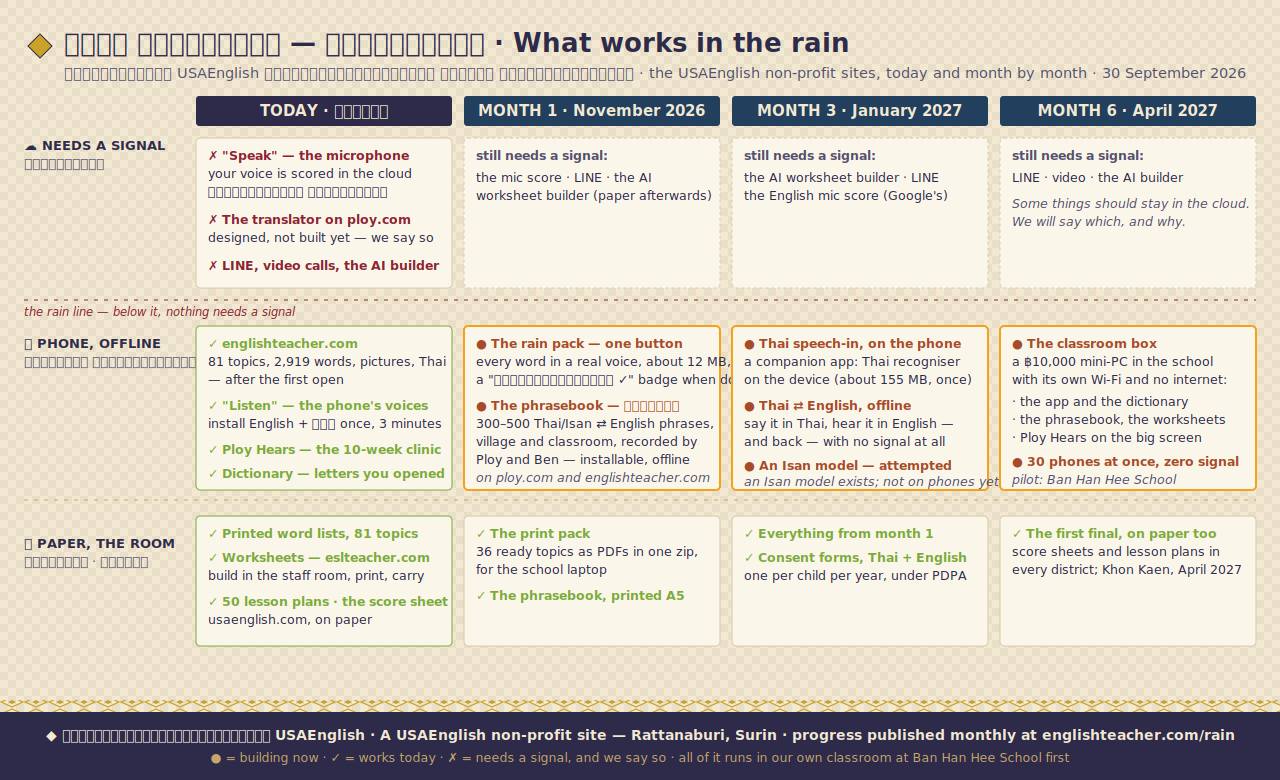
| Phone version: offline, push-to-talk, recognized text shown for confirmation. | months 1–3 |
| Classroom rig: small PC, speakerphone, lapel mic, wall display. | months 2–3 |
| The teacher's timbre on the synthetic voice, enrolled in the teacher's own language. | months 4–12, if the phone CPU can carry it |
| An Isan-to-Standard-Thai normalizer — the missing piece between Isan speech and every existing Thai model. Nobody has built it. If we do, it is published openly, because it matters beyond this classroom. | months 4–12 |
If you teach in Isan and want to try it in your room when it exists, write to ploy@ploy.com. We will tell you plainly what works yet and what does not.